Introduction
Spain’s quarrying regions, from Galician granite and slate to Macael marble and the limestone of Alicante and Murcia, place different demands on drilling equipment. This article explains where a handheld rock drill for a stone quarry in Spain fits, where a mounted pneumatic drifter for quarrying may be assessed, and how bench and production holes differ between aggregate and dimensional stone work. It covers granite, limestone and marble requirements, drill steel and bit selection, dust control, productivity and durability.
Pneumatic Drilling Equipment for Spain’s Varied Stone Regions
Spain has no single quarrying industry. Aggregate quarries drill to fragment rock for crushing, while dimensional stone quarries drill to separate blocks that must stay intact. The same pneumatic drilling equipment in Spain can appear in both, but the objective, the hole pattern and the tolerance for damage are very different.
Buyers often group these products under stone mining tools, yet the real work is quarrying and natural stone extraction, where the rock, the value of the block and the air supply shape each purchase. Quarry drilling tools for Spanish operations that suit Pontevedra granite face different wear than those working Almería marble or Alicante limestone.
Quarry Drilling Tools Across Spain’s Natural Stone Regions
Spain’s stone industry is organized in clusters, each with its own rock and extraction logic. In Galicia, the quarries of O Porriño in Pontevedra work granite of two commercial types, Rosa Porriño, which is coarse in grain, and the more abundant Rosa Dante, which differs in composition. Valdeorras in Ourense is slate country, with quarrying and slate production around O Barco de Valdeorras and many slate workings opened in Carballeda de Valdeorras. Weather varies too: Spain’s meteorological agency AEMET describes abundant winter rainfall in much of Galicia and markedly less towards the east, so wet exposure should be assessed quarry by quarry.
In Almería, the marble comarca around Macael, Olula del Río and Cantoria sits on the Sierra de los Filabres. White marble is the base of production, alongside grey marble, cipollino, serpentine and marbled dolomite. Tools for natural stone extraction here serve block separation, not fragmentation.
Alicante’s Vinalopó “Marble Corridor” includes Novelda, Pinoso, Monóvar and La Romana. Crema Marfil, a beige limestone marketed as marble, comes from Monte Coto in Pinoso, while Novelda has no quarries but is important in final processing. In Murcia, Cehegín and Caravaca de la Cruz are associated with red nodular Jurassic limestones. In Castilla y León, slate quarrying concentrates in La Cabrera, Congosto and Páramo de Sil in León.
| Region | Verified Stone Activity | Possible Drilling Requirement | Main Selection Consideration |
|---|---|---|---|
| Galicia | Granite at O Porriño and slate in Valdeorras | Bench or localized drilling | Hardness, abrasiveness and weather exposure |
| Almería | Marble and dimensional stone around Macael | Controlled production holes | Alignment and block preservation |
| Alicante | Crema Marfil limestone at Pinoso | Bench and extraction drilling | Stone characteristics and damage control |
| Murcia | Red nodular limestone at Cehegín and Caravaca de la Cruz | Production or localized drilling | Geology, dust and site conditions |
| Castilla y León | Slate in La Cabrera | Bench and localized drilling | Bench layout, layering and spare parts logistics |
Bench and Production Hole Drilling for Spanish Quarries
Bench height, hole direction and spacing follow the stone and the extraction objective, not the tool. No universal pattern applies, and this article proposes no blast designs.
Production drilling is where aggregate and dimensional stone work separate. In an aggregate or limestone operation, production holes repeat across a face. The quality questions are consistency of collar position, depth and direction, hole cleaning, drilling sequence, and tracking tool wear so that hole quality does not drift over a shift.
In granite or marble extraction, production holes exist to release or separate blocks along planned lines. Position and alignment are checked against the line before a hole is accepted, natural fractures and visible defects influence placement, and the sequence protects the block. The same rock drill or drifter may drill both kinds of hole, but the acceptance criteria differ.
Localized secondary drilling, such as reducing oversize pieces, is a third task, usually handled with handheld tools.
Handheld Rock Drills for Stone Quarry Work in Spain
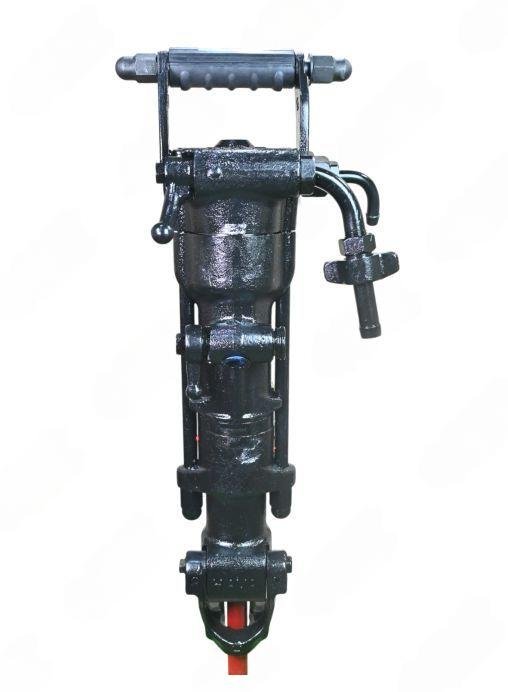
Handheld rock drills earn their place where mobility matters: localized holes, restricted access, bench preparation, secondary drilling, maintenance work and short tasks. A rock driller working a narrow slate face in La Cabrera can position a lightweight drill where a mounted arrangement would not fit.
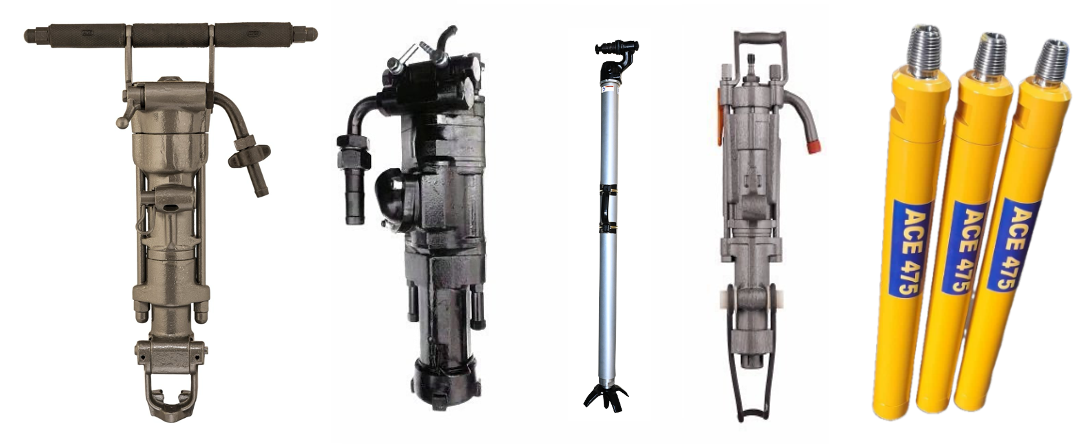
ACE Pneumatics lists its rock drills at roughly 10 to 28 kg and describes the ACE RD 658 for quarry work, bench drilling, secondary holes and drilling in granite. For the RD 658 it states holes of 27 to 40 mm and depths up to 6 metres with H22 integral rod or extension steels. Rock drill manufacturers state weight by model, and it should be judged against the working position, since overhead, horizontal and downward holes tire an operator differently. Handheld drilling is not a substitute for a production pattern.
Mounted Pneumatic Drifters for Quarrying and Repetitive Drilling
A pneumatic drifter drill is a heavier percussion unit carried by a drilling arrangement, not by an operator. ACE Pneumatics describes its drifters as typically mounted on drill rigs such as crawler drills and wagon drills, and lists continuous drilling, drifting, tunnelling, mining and large construction among the applications, alongside quarrying. The ACE 120F and ACE 120FZ are both listed at 70 kg, which is a matter for mounting and handling, not for hand use.
Mounting is the first thing to settle. Pneumatic drifter manufacturers should be asked for the feed and mounting requirements of each model, and any pneumatic drifter accessories needed to carry the unit should be identified before purchase. A mounted drifter may be evaluated for repetitive hole patterns, longer holes, controlled feed and a stable drilling direction, such as production lines on a limestone bench. It is not automatically more productive. A small dimensional stone quarry with short, varied holes may find handheld drills more practical.
Rock Drilling Tools for Granite, Limestone and Marble
Granite Quarry Drilling
In Galicia, granite matters mainly through wear. Rosa Porriño is coarse in grain and the two commercial types differ in composition, so tooling wear can differ between quarries and even between faces. Inspection intervals should follow observed wear, because worn tooling can affect hole straightness.
Limestone Quarry Drilling
Limestone is not one rock. Crema Marfil at Pinoso is a beige limestone marketed as marble, the red Cehegín limestones are nodular, and layering, fracturing, moisture and abrasiveness change from quarry to quarry. An aggregate hole tolerates roughness, while a hole for stone separation does not. Record how the rock behaves at each face before finalizing tooling.
Marble and Dimensional Stone Drilling
Macael white marble is valued as a block, so drilling is governed by hole position, spacing, natural fractures, visible defects and the risk of unwanted cracking. Maximum impact does not automatically give the best result. Feed, alignment and rotation control matter more than energy.
Drill Steel and Bit Selection for Rock Drills and Drifters
Drill steel and bits are separate items, and both must fit the drill. Stone type and hole dimensions narrow the choice, but shank and thread compatibility decide what can actually be fitted. Replacement availability matters as much as first cost, because tooling wears fastest. A rock drill supplier should confirm compatibility with the exact drill model in writing, and no combination should be assumed.
Dust Control and Worker Protection in Quarry Drilling
Spain’s occupational safety institute, INSST, notes that drilling, cutting and crushing rock generates respirable crystalline silica. Real Decreto 1154/2020 treats work that generates this dust as work under the carcinogen framework, and ITC 02.0.02, approved by Orden TED/723/2021 under the General Regulation of Basic Mining Safety Standards, addresses risk assessment, dust measurement, preventive measures, respiratory protection training and health surveillance. This article gives no exposure limits.
Risk control works best in order of priority:
- At source: use wet drilling or dust capture at the collar where the rig and site allow, and choose a hole cleaning method that does not release dust into the work area.
- In the work area: plan tasks so fewer people are exposed, keep operators out of the dust plume, and use ventilation deliberately.
- In housekeeping: clean equipment by methods that do not raise settled dust, and avoid dry sweeping or blowing down with compressed air.
- At the person: treat respiratory protection as the last layer, with trained users, correct fit and maintained equipment.
- In verification: measure exposure to confirm controls work, and keep health surveillance in place.
ACE Pneumatics describes a drifter rotation arrangement that allows changing between water and air flushing. Confirm with ACE Pneumatics how that fits a dust plan before assuming any suppression capability.
Productivity and Durability of Pneumatic Drilling Equipment
Productivity comes from the whole drilling system, and no output figure can be promised. Buyers should confirm required air pressure, air consumption and compressor capacity, including simultaneous tool use. Hose diameter, hose length, pressure loss and coupling condition all affect what reaches the tool, and moisture or poor lubrication in the air line accelerates wear.
Durability depends on correct application, clean compressed air, moisture control, lubrication as specified by the manufacturer, hose and fastener inspection, wear monitoring and careful storage. Pneumatic drifter spares such as pistons, rifle bars and valves are worth stocking for critical drills at remote quarries like those in the Filabres or La Cabrera, and the stock list should be agreed at the ordering stage, not after the first breakdown.
Selecting a Rock Drill or Pneumatic Drifter for a Spanish Quarry
Before contacting pneumatic drifter suppliers or any other source, gather:
- Quarry location and region
- Stone type
- Aggregate or dimensional stone operation
- Bench geometry
- Required hole diameter and depth
- Hole direction
- Handheld or mounted operation
- Compressor capacity and hose configuration
- Drill steel and bit compatibility
- Dust control method
- Maintenance resources
- Spare parts availability
- Technical documentation
ACE Pneumatics Pneumatic Drifters and Rock Drills for Spain
ACE Pneumatics Pvt. Ltd. is an Indian manufacturer, exporter and supplier of mining tools, and its distribution network includes Spain. Its pneumatic drifters are the ACE 120F and ACE 120FZ, and its handheld rock drills include the ACE RD 658, ACE RD 12D and ACE RD 12T. ACE Pneumatics lists pneumatic drifter spare parts for both drifter models, including pistons, rifle bars and valves, and rock drill spares including pistons, front heads, valves, sleeves and tappets.
For Spanish buyers sourcing quarry equipment from India, lead times and export documentation deserve the same scrutiny as the tool, and pneumatic drifter exporters and rock drill exporters should each supply manuals and spare parts lists for their models.
Send ACE Pneumatics the details from the checklist above, together with the expected operating intensity, the preferred handheld or mounted configuration and the required quantity. Hole range, air consumption and compatible steel for each model should be confirmed directly with ACE Pneumatics.
Conclusion: Selecting Pneumatic Drilling Equipment for Spanish Quarries
Equipment selection should begin with the quarry’s production objective. Aggregate operations need consistent production holes for controlled fragmentation, while dimensional stone operations place greater emphasis on alignment, separation accuracy and protection of the finished block.
ACE Pneumatics offers handheld rock drills, mounted pneumatic drifters and corresponding spare parts for quarrying and mining applications. Quarry operators, drilling contractors, importers and distributors in Spain can send their application details to ACE Pneumatics for technical product evaluation.
Ready to source pneumatic drifter?
Tell us your quantity and destination. We send specs, pricing and lead time within 1 business day.

Dilawar Sayyad
Global Business Manager, Ace Pneumatics Pvt. Ltd.
15+ years in international business development, helping importers, dealers and contractors source durable construction, demolition and mining tools.